
The Bottle House Is Ready
for Its Next Chapter.
One of Metro Detroit’s most unforgettable homes has just become dramatically more attainable.

Some homes are built.
Others become part of a place.
The Bottle House belongs firmly in the second category.
Built in 1937 by Omar Reese, this Hazel Park landmark became one of Metro Detroit’s most unusual examples of folk architecture.
Thousands of glass bottles were incorporated directly into its construction, transforming a modest home into something people have stopped to look at for generations.
Nearly nine decades later, the home has been restored, reimagined and preserved — and now it is ready for someone new to carry the story forward.

The Story Is Built Into the Walls
What makes the Bottle House memorable is that its history is not simply something written about the property afterward.
You can see it.
Blue glass. Green glass. Amber glass. Clear glass.
Bottle after bottle became part of the architecture itself.
They were not simply decorations added to a finished house.
They became part of the house.
See the Bottle House in 60 Seconds
Want the quick version first? Take a walk through the Bottle House in this short History Loves Company Reel.
Watch the ReelThe Full Story of the Bottle House
The Reel gives you a glimpse. The full film explains how this unusual little house came to exist, why bottles became part of its walls and how it was brought back for another generation.
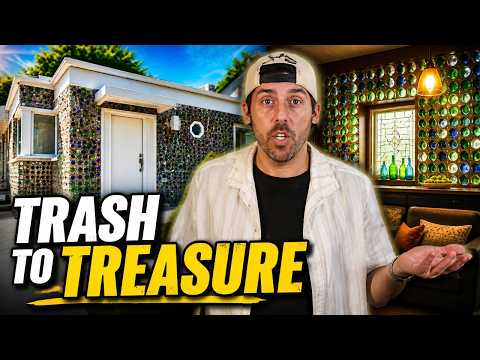 Watch the Full Film
Saved, Not Frozen in Time
Preserving an unusual home does not mean refusing to let it evolve.
The Bottle House underwent an extensive restoration that preserved the architecture people recognize while transforming the interior into something bright, comfortable and surprisingly contemporary.
That contrast is one of its greatest strengths.
From the street, there is nothing else like it.
Walk through the door and you discover a home designed to actually be lived in.

A Home Meant to Be Lived In
The Bottle House offers approximately 1,225 square feet with two bedrooms, updated living spaces and a detached two-car garage.
The renovation brought modern functionality into the home without erasing the personality that made it memorable in the first place.


A Little More Room to Imagine
Off the walkout lower level is additional bonus space that adds another dimension to the property.
Home office. Studio. Hobby room. Lounge. Creative workspace.
It is flexible enough to become whatever its next owner needs.

Come Inside the Bottle House
This is one of those properties photographs cannot completely explain. So this September, we are opening the doors twice.
An Evening at the Bottle House
Join us for a special evening inside one of Hazel Park’s most unusual homes. Explore the restoration, see the bottles up close and experience the property as daylight begins to fade.
The Bottle House Open House
Miss the evening event? We are opening the Bottle House again after Labor Day for buyers, neighbors, architecture lovers and anyone who has always wondered what is behind those walls.
There Is No Comparable House
Most homes can be compared to something else nearby.
Another ranch. Another bungalow. Another renovation.
The Bottle House does not work that way.
You are not simply buying a two-bedroom home in Hazel Park.
You are buying a neighborhood landmark. A conversation piece. A surviving piece of Michigan folk architecture. A house people remember after seeing it once.
39 W. Elza Avenue
Built 1937
Thousands of Embedded Glass Bottles
2 Bedrooms
Approx. 1,225 Sq. Ft.
Renovated Interior
Walkout Lower Level
Flexible Bonus Room
Detached 2-Car Garage
Own the House Everyone Remembers.
The Bottle House has spent nearly 90 years making people stop and look. Now someone new gets to become part of its story.
Explore the Listing Request a ShowingExperience the Bottle House
Chris Hubel
@properties Christie’s International Real Estate
248-568-6030
[email protected]
Explore the Bottle House →
Stories We Keep is about the homes, buildings, streets and landscapes that survive long enough to become part of who we are.
Sometimes the story is hidden.
Sometimes it is embedded right into the walls.